Before I tell you the details about my research I want to say that I do what I do because I love being a scientist and studying nature. But also, because we need to know our natural resources in order to protect them and I hope my research contributes to achieve that.
Understanding bee to hummingbird pollination shifts: Ph.D. thesis
Plants are the second most diverse group of living organisms, and within them, the flowering plants or angiosperms is the largest group. Around the world, tropical regions are spots that harbor a high diversity of angiosperms, particularly the Neotropics. This fact raised the question, why is there such great angiosperm diversity in the Neotropics? Extensive evidence suggests that plant-pollinator interactions are a significant cause of angiosperm diversification. One important mechanism for pollinator-driven speciation is the transition between pollination systems, known as pollination shifts.
My Ph.D. dissertation focuses on understanding pollination shifts using a tropical plant system (genus Costus; family Costaceae). I studied the Neotropical Costus clade because it exhibits many parallel shifts from orchid bee to hermit hummingbird pollination. Furthermore, bee- and hummingbird-pollinated Costus species are associated with different suites of floral traits. I used various approaches, from field sampling and experimentation, quantitative floral trait analyses, and pollinator quality comparison in hyper-diverse Neotropical ecosystems in Central (Costa Rica) and South America (Peru). I examined how intrinsic (floral traits) and extrinsic (elevation, pollinator assemblage, pollinator quality) factors may drive pollination shifts and how floral traits change during a pollination shift.
Before I tell you more, meet the Neotropical spiral gingers, known as “caña agria” in Spanish speaking regions of Central and South America.


- Analyzing floral traits and pollinator assemblages variation along an elevational gradient in the species Costus guanaiensis var. tarmicus
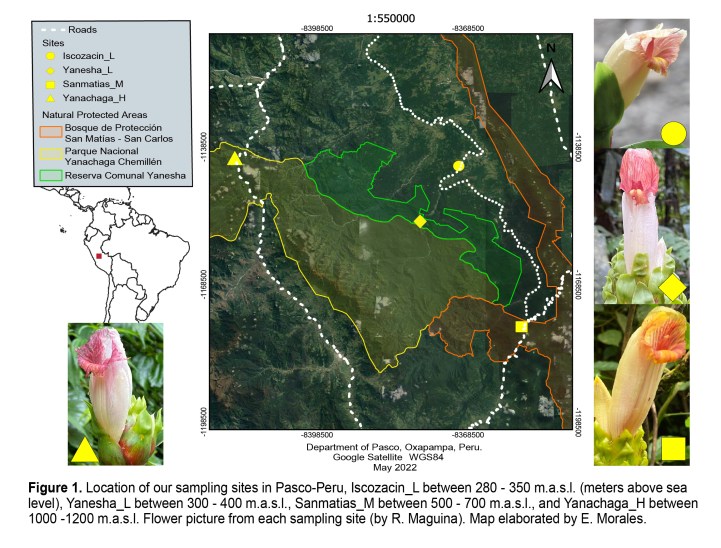
Previous studies suggested that environmental factors such as elevation can alter pollinator assemblages and favor hummingbirds over bees as pollinators, promoting a pollination shift. Bee diversity and abundance decrease with elevation. In contrast, hummingbirds can inhabit a wider elevational range than bees and perform well as pollinators in high elevation areas. We asked whether floral traits and pollinator assemblages vary among sites along an elevational gradient and whether there is an association between pollinator and floral trait variation.
We found variation in floral traits of size, color, and reward and in the pollinator assemblages along the elevational gradient. In addition, our results demonstrated that corolla width across sites was associated with bee thorax width, providing evidence for local adaptation of C. guanaiensis var. tarmicus populations to the bee fauna along the studied elevational gradient (local bee adaptation hypothesis). However, we could not rule out the possibility of an incipient bee-to-hummingbird pollination shift in the highest-elevation site. Because in the highest site, we found floral traits of C. guanaiensis var. tarmicus that might work in hummingbird fitting and attraction and the presence of hummingbirds in the pollinator assemblage, which were absent in lower sites. Maguiña-Conde, R., Zúñiga-Rivas, D., & Kay, K.M. (2023). An elevational gradient in floral traits and pollinator assemblages in the Neotropical species Costus guanaiensisvar. tarmicus in Peru. Ecology and Evolution, 13, e10314. (Link to the article) (Español_Maguiña-Conde et al. 2023. Ecology & Evolution)
- Testing anti-bee and pro-bird floral traits in the Neotropical Costus clade
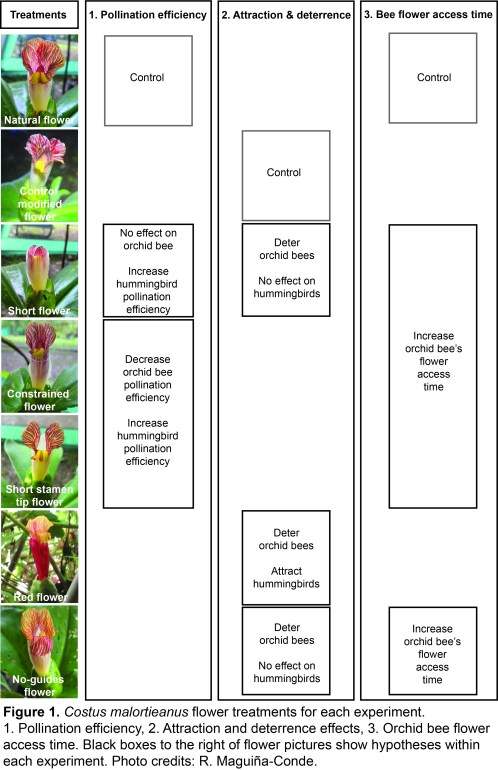
Pollination shifts may involve floral changes that deter ancestral pollinators and attract new ones. We investigated floral traits in a Neotropical plant, Costus malortieanus, that might deter and diminish the pollination efficiency of orchid bees (anti-bee traits) as well as attract and increase the pollination efficiency of hummingbirds (pro-bird traits). We modified flower size, shape, and color in C. malortieanus and exposed modified flowers to orchid bees and hummingbirds.
- Bees and hummingbirds transfer similar heterospecific pollen loads as pollinators of Neotropical plant species
Heterospecific pollen (HP) transfer happens between individuals of different species that share pollinators. HP transfer is common, could detrimentally affect plant fitness and is an underestimated driver of floral evolution. Pollinator quality could explain HP transfer patterns. Birds are often assumed to be better pollinators than bees, but no studies have compared bee versus bird pollinator quality in terms of HP transfer or investigated the underlying plant-plant interactions assessed through HP and conspecific pollen loads relationship. Researchers have proposed that the higher pollinator quality of birds may favor evolutionary changes in pollination systems from bee to bird, called “pollination shifts.” We elucidated differences in HP transfer between bee and bird pollinators and assessed the plant-plant pollinator-mediated interactions in bee- and bird- plant pollinated communities in tropical areas.

Nectar-bats and their flowers: Master’s and undergraduate research
For several years I worked on the ecology and conservation of plant and nectar-bat interactions. I was, I am and I always will be interested in studying these interactions. I love nectar-bats!!! I am constantly looking for collaborators (undergraduate or graduate students, faculty, independent researchers) to continue studying them.
Plants pollinated by nectar-bats possess unique characteristics to attract them in order to be successfully pollinated. Also, those pollinator nectar-bats have evolved several adaptations to feed from nectar and pollen. It is important to register and study these interactions, but also to analyze which activities could threaten them, in order to conduct optimal management decisions for their conservation.
- The effects of artificial nectar feeders on bat-plant interactions:
When artificial nectar feeders are available in an area, they could draw pollinators away from plants. We tested the effects of artificial nectar feeders in an Ecuadorian cloud forest. We divided the study site into areas close to (~30 m) and far from (~500 m) three different feeder sites. We found that areas close to feeders have higher relative bat abundance by a factor of 40. In spite of this, the presence of feeders did not affect bat pollen loads, nor the flower visitation rates and breeding success of bat-pollinated species Burmeistera glabrata.
Maguiña, R., & Muchhala, N. (2017). Do artificial nectar feeders affect bat–plant interactions in an Ecuadorian cloud forest?. Biotropica, 49(5), 586-592. [Link to the article]


- Anoura fistulata, a nectar-bat with a striking tongue adaptation:
We described the diet of A. fistulata in a broader distribution range of the species, adding 13 new plant species to its known diet. We found that A. fistulata is the only visitor to the extremely long flowers of the species Centropogon nigricans and Marcgravia williamsii, whose nectar is inaccessible to other bat species with shorter tongues. However, A. fistulata does not have a more specialized diet than other nectar-bats, and it can occur in sites that lack long flower species. Finally, we found a geographic trait covariation between the tongue length of A. fistulata and the nectar depth of the species with the longest flower it consumes, supporting the geographic mosaic theory of coevolution. [Link to my Master’s thesis]


- Platalina genovensium in the coastal lomas ecosystem:
The long-snouted bat (Platalina genovensium) is an endemic nectar-feeding bat from arid regions in western Peru and Chile. We conducted monthly evaluations of bats and plants in the lomas of the National Reserve of Lachay (Peru). The dietary components of P. genovensium included nectar, pollen, fruits, and insects. Pollen of the genus Haageocereus (Cactaceae) was the most frequent and abundant resource recorded; moreover, the niche breadth analysis revealed a specialized diet on the Haageocereus cactus in Lachay. Finally, we suggest that P. genovensium could serve as a pollinator for H. acranthus, H. pseudomelanostele, and Puya ferruginea (Bromeliaceae).
Maguiña, R., & Amanzo, J. (2016). Diet and Pollinator Role of the Long-Snouted Bat Platalina genovensium in Lomas Ecosystem of Peru. Tropical Conservation Science, 9(4), 1940082916674288. [Link to the article]


- Diet of bats from a Peruvian cloud forest:
We evaluated the diet of phyllostomids bats from the montane forest of the Kosñipata Valley (San Pedro, Cusco). The bat species belong to the genus Carollia, Sturnira and Anoura. The diet was described based on the presence of pollen and seeds in bat’s fecal samples. The results showed that the bats mainly feed on fruits and nectar-pollen. The principal resources registered belong to the genus Piper (23,08%), Cecropia (21,15%) and Abutilon (13,46%), which were the most important resources for the bat’s community.
Maguiña, R., Amanzo, J., & Huamán, L. (2012). Dieta de murciélagos filostómidos del valle de Kosñipata, San Pedro, Cusco-Perú. Revista Peruana de Biología, 19(2), 159-166. [Link to the article]
 Rossana Maguiña-Conde